Tanzania, home to Mount Kilimanjaro and the vast Serengeti plains, captivates visitors with its natural wonders and rich cultural heritage. Whether you’re planning a safari adventure, climbing Africa’s highest peak, or exploring the spice markets of Zanzibar, understanding Tanzania’s currency is essential. The Tanzanian shilling (TZS) serves as the lifeblood of local commerce, connecting travelers to authentic experiences throughout this East African nation. Join us as we journey through the history, present, and future of Tanzania’s currency system – knowledge that will enhance your travel experience and provide valuable insights into this vibrant economy.
Historical Background of Tanzanian Currency
Evolution of Tanzania’s currency from colonial times to modern shillings
Pre-Independence Currency Systems
Before Tanzania emerged as an independent nation, its currency journey reflected the complex tapestry of colonial influence in East Africa. In the late 19th century, when the German East Africa Company established a protectorate in Tanganyika, the German rupie became the first official currency in 1890. These silver coins held equivalent value to the rupees circulating in India and Zanzibar during that period.
Following World War I and Germany’s defeat, British administration introduced the East African florin. This currency had a brief circulation period due to the rising cost of silver and limited distribution. The East African shilling soon replaced it in 1921, becoming the standard currency throughout British-controlled East Africa, including what would later become Tanzania, Kenya, and Uganda.
Birth of the Tanzanian Shilling
The journey toward monetary independence began in earnest after Tanzania (then Tanganyika) gained independence in 1961, followed by Zanzibar in 1963. The two territories united to form Tanzania in 1964. On June 14, 1966, Tanzania introduced its own currency – the Tanzanian shilling – replacing the East African shilling at par value (1:1).
This currency transition marked an important step in Tanzania’s sovereignty, allowing the new nation to control its monetary policy and establish economic independence. The Bank of Tanzania, established in 1966, took responsibility for issuing and managing the new currency.
Currency Reforms and Changes
Over the decades, the Tanzanian shilling has undergone several significant reforms and changes. In the 1980s, economic liberalization policies led to major currency adjustments as Tanzania moved away from a socialist economic model. The 1990s saw further reforms as the country embraced market-oriented policies, affecting the shilling’s value and stability.
Banknote designs have evolved to reflect Tanzania’s cultural heritage and natural resources. Early notes featured Tanzania’s first president, Julius Nyerere, alongside images of economic activities and wildlife. More recent series incorporate enhanced security features while continuing to celebrate Tanzania’s national identity through imagery of iconic landmarks and fauna.
Planning a Trip to Tanzania?
Get expert guidance on currency exchange, best rates, and safe money handling during your Tanzanian adventure.
Current Tanzanian Currency System
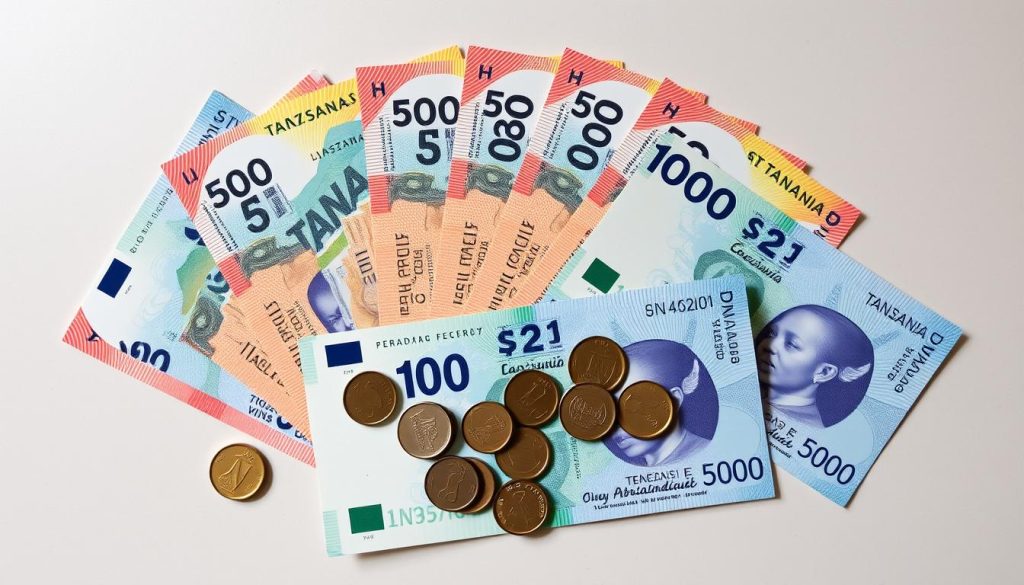
Current Tanzanian shilling banknotes and coins in circulation
The Tanzanian Shilling (TZS)
The Tanzanian shilling (code: TZS, symbol: TSh) serves as Tanzania’s official currency. As a closed currency, you can only purchase Tanzanian shillings within Tanzania itself. The currency divides into 100 cents, though inflation has rendered cent coins largely obsolete in daily transactions.
Until recently, the US dollar was widely accepted throughout Tanzania, particularly in tourism-related businesses. However, in March 2025, the government implemented new restrictions prohibiting businesses from charging in foreign currencies. This policy change means all local transactions within Tanzania must now be conducted in Tanzanian shillings only.
Banknotes and Coins in Circulation
Current Tanzanian banknotes in circulation include denominations of 500, 1,000, 2,000, 5,000, and 10,000 shillings. These notes feature distinctive designs celebrating Tanzania’s wildlife, landmarks, and cultural heritage. The 10,000 shilling note, the highest denomination, displays the Bank of Tanzania headquarters in Dar es Salaam on its reverse side.
Coins currently in circulation include denominations of 50, 100, 200, and 500 shillings. The 500 shilling coin, introduced in 2014, represents the highest coin denomination. Lower value coins (5, 10, 20 shillings) have largely disappeared from circulation due to inflation.
| Denomination | Type | Main Color | Main Design Features |
| 500 TSh | Banknote | Green | African Buffalo, Nkrumah Hall |
| 1,000 TSh | Banknote | Blue | Julius Nyerere, State House |
| 2,000 TSh | Banknote | Orange-brown | Lion, Mount Kilimanjaro, Stone Town Fort |
| 5,000 TSh | Banknote | Purple | Black Rhinoceros, Geita Gold Mine |
| 10,000 TSh | Banknote | Red | Elephant, Bank of Tanzania Headquarters |
Currency Notation and Symbols
Tanzania uses a unique notation system for displaying prices, modeled after the British pre-decimal notation of pounds, shillings, and pence. Prices are written in the form x/y, where x represents the amount in shillings and y represents cents.
For example, 50 cents is written as “-/50” while 100 shillings appears as “100/=” or “100/-“. When the amount includes both shillings and cents, it would be written as “150/50” for 150 shillings and 50 cents. Sometimes the abbreviation TSh precedes the amount for clarity, especially in formal documents or when writing out large sums (e.g., TSh 10 million).
The Bank of Tanzania’s Role
The Bank of Tanzania (BOT), established in 1966, serves as the country’s central bank. Headquartered in Dar es Salaam, the BOT holds responsibility for issuing currency, implementing monetary policy, and maintaining price stability. The bank also regulates and supervises financial institutions throughout Tanzania.
In addition to currency management, the Bank of Tanzania works to promote financial inclusion, develop payment systems, and maintain foreign exchange reserves. Its policies directly influence the stability and value of the Tanzanian shilling in domestic and international markets.
Exchange Rate Analysis
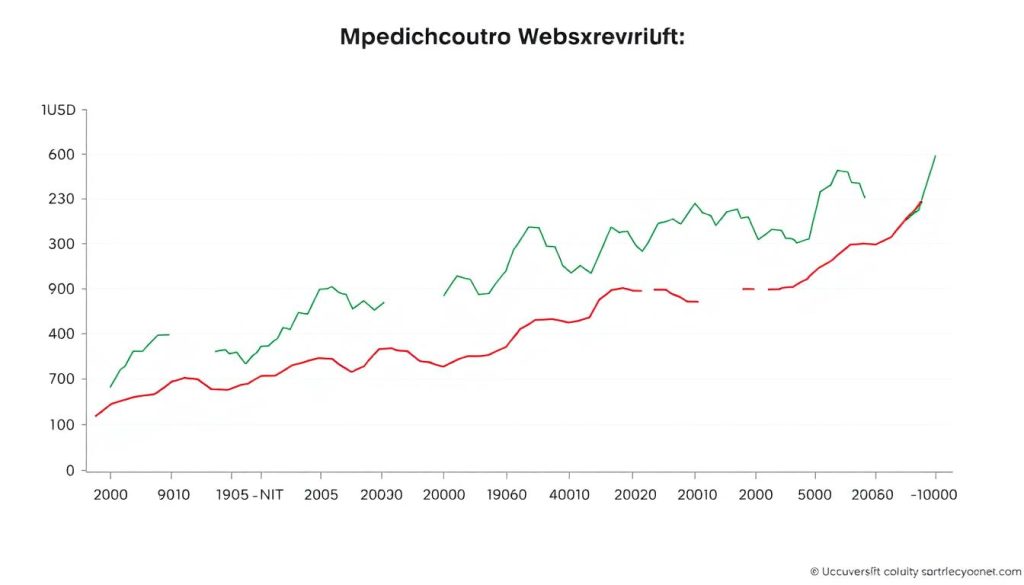
Exchange rate trends of the Tanzanian shilling against major world currencies
Current Exchange Rates
The Tanzanian shilling maintains a floating exchange rate that fluctuates based on market forces. As of the latest available data, approximate exchange rates for the Tanzanian shilling against major world currencies are:
| Currency | Exchange Rate to 1 Unit | Equivalent in TSh |
| US Dollar (USD) | 1 USD = 2,700 TSh | 10,000 TSh ≈ 3.70 USD |
| Euro (EUR) | 1 EUR = 2,900 TSh | 10,000 TSh ≈ 3.45 EUR |
| British Pound (GBP) | 1 GBP = 3,500 TSh | 10,000 TSh ≈ 2.86 GBP |
| Kenyan Shilling (KES) | 1 KES = 18 TSh | 10,000 TSh ≈ 556 KES |
| South African Rand (ZAR) | 1 ZAR = 145 TSh | 10,000 TSh ≈ 69 ZAR |
These rates fluctuate daily based on market conditions. For the most current rates, check reliable sources like the Bank of Tanzania website, major banks, or reputable currency conversion websites such as XE.com.
Historical Exchange Rate Trends
Over the past decade, the Tanzanian shilling has experienced a general depreciation trend against major world currencies, particularly the US dollar. This trend reflects Tanzania’s economic challenges, including inflation pressures and trade imbalances.
In the early 2010s, the shilling traded at approximately 1,500 to the US dollar. By 2015, this rate had weakened to around 2,000 TSh per dollar, and it has continued to gradually depreciate since then. This long-term trend reflects broader economic factors rather than short-term fluctuations.
Factors Influencing Exchange Rates
Several key factors influence the Tanzanian shilling’s value against other currencies:
- Inflation rates – Tanzania’s inflation directly impacts the shilling’s purchasing power
- Trade balance – Tanzania’s import/export ratio affects currency demand
- Foreign investment – Direct investment flows influence currency stability
- Government policies – Fiscal and monetary decisions impact currency value
- Tourism fluctuations – As a major foreign exchange earner, tourism affects currency demand
- Global economic conditions – Particularly commodity prices for Tanzania’s exports
Where to Exchange Currency
When visiting Tanzania, you have several options for exchanging currency:
Official Exchange Bureaus (Forex)
Licensed foreign exchange bureaus offer competitive rates and display their daily rates prominently. These “forex” offices can be found in major cities, tourist areas, and at international airports. Recent regulations require visitors to use only these official channels for currency exchange.
Banks
Major banks, including the Bank of Tanzania, provide currency exchange services with reliable rates, though they may not always offer the most competitive exchange. Banks typically operate during standard business hours on weekdays.
ATMs
ATMs are widely available in cities and larger towns, allowing you to withdraw Tanzanian shillings directly using international debit or credit cards. This option often provides exchange rates close to the interbank rate, though your home bank may charge foreign transaction fees.
Important: Recent regulations prohibit the use of foreign currency for local transactions in Tanzania. All purchases must be made in Tanzanian shillings, and visitors must use official channels for currency exchange. Avoid street money changers, as these transactions are illegal and risky.
Get the Best Currency Exchange Rates
Receive personalized advice on where to find the most favorable exchange rates for your Tanzania trip and avoid common currency pitfalls.
Comparative Analysis with Other African Currencies

Comparative analysis of major African currencies including the Tanzanian shilling
East African Community Currencies
The East African Community (EAC) comprises Tanzania, Kenya, Uganda, Rwanda, Burundi, and South Sudan. Each maintains its own currency, though there have been discussions about a potential East African monetary union.
The Kenyan shilling (KES) typically maintains a stronger position than the Tanzanian shilling, with 1 KES worth approximately 18 TSh. The Ugandan shilling (UGX) is valued lower than both, with 1 USD equaling roughly 3,700 UGX compared to 2,700 TSh.
Rwanda and Burundi use francs (RWF and BIF respectively), which have different valuation structures than the shillings. South Sudan’s pound (SSP) has faced significant challenges due to political instability and economic crises.
Comparison with Major African Economies
When comparing Tanzania’s currency with those of Africa’s largest economies:
| Country | Currency | Approx. Value vs. USD | Relative Stability |
| Tanzania | Tanzanian Shilling (TSh) | 2,700 TSh = 1 USD | Moderate |
| South Africa | Rand (ZAR) | 18 ZAR = 1 USD | Higher |
| Nigeria | Naira (NGN) | 1,500 NGN = 1 USD | Lower |
| Egypt | Pound (EGP) | 30 EGP = 1 USD | Moderate |
| Morocco | Dirham (MAD) | 10 MAD = 1 USD | Higher |
The South African rand stands out as one of Africa’s most traded and stable currencies, supported by South Africa’s diversified economy and developed financial markets. The Nigerian naira has faced significant challenges due to oil price fluctuations and economic policies.
Regional Currency Stability
Currency stability varies significantly across African regions. North African currencies like the Moroccan dirham and Egyptian pound benefit from diversified economies and tourism. West African nations using the CFA franc (XOF) enjoy relative stability due to their peg to the euro.
East African currencies, including the Tanzanian shilling, have shown moderate stability compared to some other regions. The Tanzanian shilling has avoided the extreme volatility seen in countries like Zimbabwe or South Sudan, partly due to prudent monetary policies by the Bank of Tanzania.
Purchasing Power Comparisons
When comparing purchasing power across African economies, the raw exchange rate doesn’t tell the complete story. The cost of living varies significantly between countries.
In Tanzania, basic food items and local services tend to be less expensive than in countries like South Africa or Kenya. For example, a basic meal at a local restaurant might cost 5,000-10,000 TSh in Tanzania, compared to equivalent meals costing more in Kenyan shillings or South African rand when converted to USD.
However, imported goods and luxury items often carry similar price tags across these economies when converted to major currencies like USD or EUR, reflecting global pricing rather than local economic conditions.
Economic Context of Tanzania’s Currency
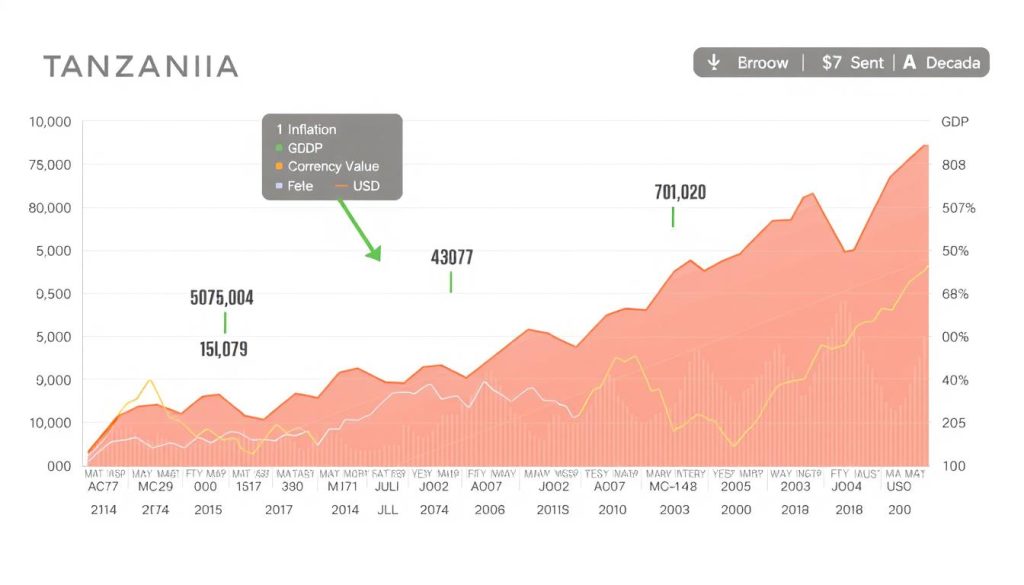
Tanzania’s key economic indicators and their relationship to currency value
Tanzania’s Economic Position in Africa
Tanzania stands as one of East Africa’s largest economies, with a GDP of approximately $67.8 billion (2022). The country has maintained relatively strong economic growth, averaging 6-7% annually over the past decade before the COVID-19 pandemic. This growth has been driven by sectors including agriculture, mining, tourism, and telecommunications.
While not among Africa’s wealthiest nations in per capita terms, Tanzania has shown consistent economic development and poverty reduction. The country’s strategic location, natural resources, and political stability contribute to its economic potential within the region.
Inflation and Currency Value
Inflation has been a persistent challenge for Tanzania’s economy and currency stability. In recent years, inflation has generally ranged between 3-5%, which is moderate by regional standards but still impacts purchasing power.
The relationship between inflation and currency value is direct – higher inflation typically leads to currency depreciation. The Bank of Tanzania implements monetary policies aimed at controlling inflation while supporting economic growth, walking a delicate balance that directly affects the shilling’s value.
Inflation Impact on Daily Life
For Tanzanians, inflation directly affects the cost of essential goods and services. When inflation rises, the purchasing power of the shilling declines, requiring more currency for the same goods. This particularly impacts lower-income households who spend a larger proportion of their income on necessities like food and transportation.
Central Bank Response
The Bank of Tanzania employs various tools to manage inflation, including interest rate adjustments, reserve requirements for banks, and open market operations. These policies aim to maintain price stability while supporting economic growth – decisions that directly influence the shilling’s domestic purchasing power and international exchange value.
Foreign Investment and Currency Stability
Foreign direct investment (FDI) plays a crucial role in Tanzania’s economy and currency stability. Major investment sectors include mining, oil and gas exploration, agriculture, and infrastructure development. These investments bring foreign currency into Tanzania, supporting the shilling’s value.
Government policies toward foreign investment have evolved over time, with recent efforts to balance attracting investment while ensuring benefits for local communities and the national economy. These policy decisions directly impact capital flows and, consequently, currency stability.
Tourism’s Effect on Currency
Tourism represents one of Tanzania’s largest foreign exchange earners, with attractions like Mount Kilimanjaro, Serengeti National Park, and Zanzibar drawing visitors from around the world. Before the COVID-19 pandemic, tourism contributed approximately 17% to GDP and generated substantial foreign currency inflows.
Seasonal tourism patterns create cyclical demand for the Tanzanian shilling, with higher demand during peak tourism seasons (June-October and December-February). This seasonality can influence exchange rates, with the shilling potentially strengthening during these periods due to increased foreign currency inflows.
The recent policy changes requiring all tourism transactions to be conducted in Tanzanian shillings aim to increase domestic use of the currency and reduce dollarization in the economy. This policy may further strengthen the relationship between tourism and currency demand.
Practical Information for Using Tanzania Currency
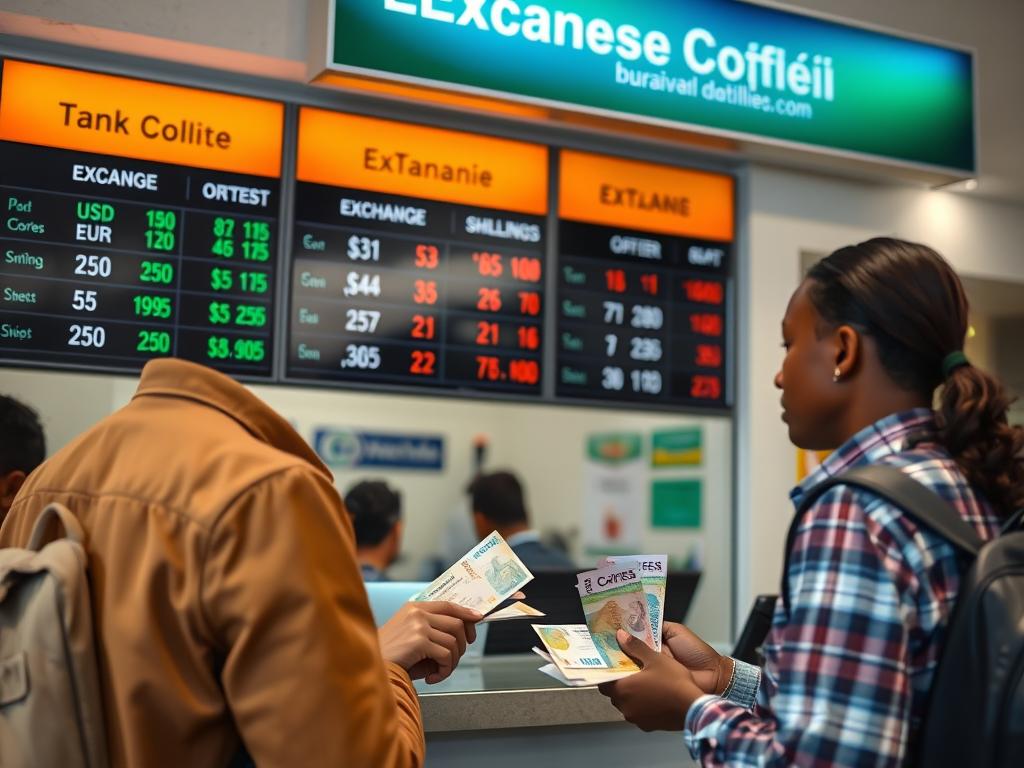
Currency exchange at an official bureau de change in Tanzania
Cash vs. Digital Payments
Cash remains king in Tanzania, particularly outside major urban centers. In smaller towns, rural areas, and local markets, Tanzanian shillings in physical form are essential for daily transactions. Street vendors, local transportation, and small shops typically accept only cash.
Digital payment options are growing in Tanzania’s urban areas. Credit and debit cards are accepted at larger hotels, restaurants, and retail establishments that cater to international visitors. Mobile money services like M-Pesa have gained significant popularity among locals, allowing money transfers and payments via mobile phones, though these typically require a local SIM card and account.
Advantages of Cash
- Universal acceptance throughout Tanzania
- No transaction fees or technical issues
- Essential for small purchases and rural areas
- No need for functioning technology or connectivity
- Often results in better prices when haggling
Disadvantages of Cash
- Security risk of carrying large amounts
- Bulky to carry (especially with larger denominations)
- No protection if lost or stolen
- Need to plan for currency exchange
- Potential for receiving counterfeit notes
ATM Availability and Banking Services
ATMs are readily available in major cities like Dar es Salaam, Arusha, Moshi, and Stone Town in Zanzibar. These machines typically accept international cards and dispense Tanzanian shillings. Most ATMs are located at bank branches rather than standalone locations, and many are accessible only during bank operating hours.
When planning to visit remote areas or national parks, withdraw sufficient cash beforehand, as ATM access will be limited or nonexistent. Major banks operating in Tanzania include CRDB Bank, NMB Bank, and Standard Chartered, all offering currency exchange services during business hours.
ATM Tips: Inform your bank about your travel plans before departing to prevent card blocks due to foreign transactions. Consider withdrawing larger amounts less frequently to minimize transaction fees, but balance this against the security risk of carrying excess cash.
Currency Restrictions and Regulations
Tanzania has implemented several currency regulations that travelers should be aware of:
- Foreign currency usage for local transactions is prohibited – all purchases within Tanzania must be made in Tanzanian shillings
- Currency exchange must occur through official channels (banks or licensed forex bureaus)
- When exchanging US dollars, only notes printed after 2006 are accepted, and they must be in good condition without tears or excessive marks
- There are limits on the amount of currency that can be brought into or taken out of Tanzania – generally around $10,000 USD equivalent without declaration
Tips for Handling Money Safely
Safety considerations when handling currency in Tanzania include:
Security Precautions
Avoid displaying large amounts of cash in public. Divide your money between different secure locations (hotel safe, money belt, different pockets) rather than keeping it all in one place. Be particularly cautious in crowded areas like markets and public transportation hubs.
Counterfeit Awareness
Examine banknotes when receiving them, checking for security features like watermarks and security threads. Higher denomination notes (5,000 and 10,000 shillings) are more likely targets for counterfeiting. When possible, request smaller denominations which are less likely to be counterfeit.
Tipping and Haggling
Tipping is customary in Tanzania’s tourism industry. For safari guides, a tip of 15-20 USD per day per group is standard. At accommodations, 5 USD per guest per night is appropriate, usually placed in a communal tip box. In restaurants, 10% is the typical gratuity.
Haggling is expected in markets and with street vendors, but not in established businesses with fixed prices. Begin by offering about half the initial asking price and negotiate from there. Conduct negotiations with a smile and friendly attitude – the process should be good-natured rather than confrontational.
Prepare for Your Tanzania Journey
Download our comprehensive Tanzania Currency Guide with offline reference charts, security feature identification tips, and regional spending insights.
Future Outlook for Tanzania’s Currency
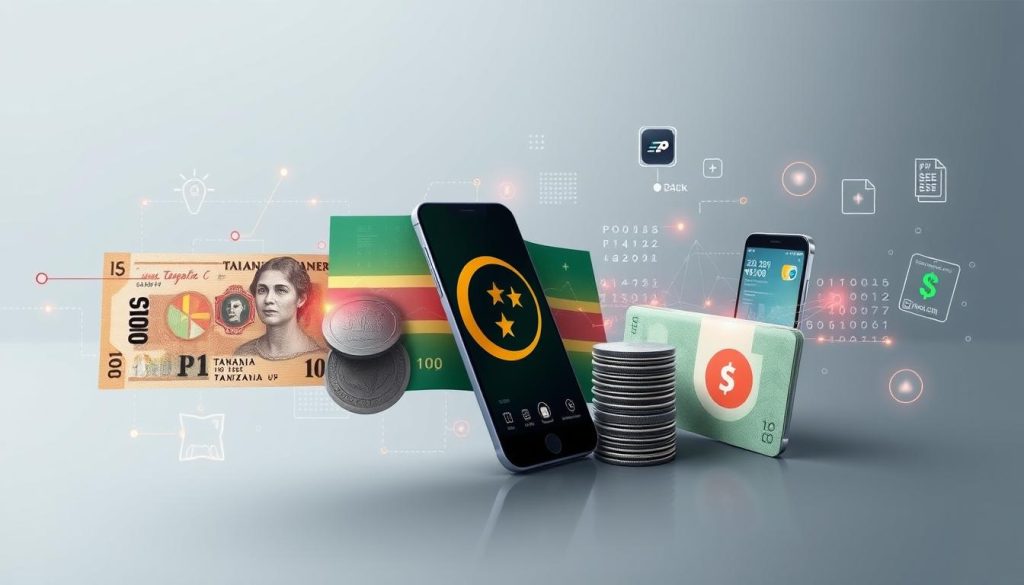
The evolving landscape of Tanzania’s currency and payment systems
Potential Currency Developments
Several factors will likely influence the future of Tanzania’s currency:
Economic diversification efforts may strengthen the shilling as Tanzania reduces dependence on traditional exports and develops new industries. The government’s focus on industrialization and value-added production could improve trade balances and support currency stability.
Infrastructure development, particularly in transportation and energy sectors, may attract increased foreign investment, potentially strengthening the currency. However, the associated debt for these projects could create pressure on the shilling if not managed carefully.
East African Currency Union Prospects
The East African Community has long discussed the possibility of a monetary union with a single currency for member states. The East African Monetary Union Protocol, signed in 2013, originally aimed for implementation by 2024, though this timeline has faced delays.
Challenges to this union include varying levels of economic development among member states, different monetary policies, and political considerations. If implemented, a unified East African currency would replace the Tanzanian shilling and potentially create a stronger regional currency with greater international recognition.
The success of such a union would depend on harmonizing economic policies, establishing strong regional institutions, and creating effective mechanisms for addressing economic shocks that affect member states differently.
Economic Projections
Economic forecasts suggest Tanzania will continue experiencing moderate growth in the coming years, with projections of 5-6% annual GDP growth. This growth, coupled with the government’s focus on fiscal discipline, could support currency stability.
Inflation management remains crucial for the shilling’s future value. The Bank of Tanzania targets keeping inflation within a 3-5% range, which would help maintain purchasing power and exchange rate stability if achieved consistently.
External factors, including global commodity prices, regional political developments, and international financial conditions, will continue to influence the shilling’s value. Tanzania’s growing integration into global markets increases these external influences on its currency.
Digital Currency Trends
Tanzania is exploring digital currency options, with the Bank of Tanzania researching the potential for a Central Bank Digital Currency (CBDC). This would represent a digital form of the Tanzanian shilling, backed by the central bank.
Mobile money services continue to transform Tanzania’s payment landscape. Services like M-Pesa, Tigo Pesa, and Airtel Money have already revolutionized financial inclusion, allowing millions of Tanzanians without traditional bank accounts to participate in the digital economy.
Blockchain and cryptocurrency adoption remains limited in Tanzania, with regulatory frameworks still developing. The government has taken a cautious approach, recognizing both potential benefits for financial innovation and risks related to consumer protection and financial stability.
Will Tanzania adopt cryptocurrency as legal tender?
Currently, this seems unlikely in the near term. Tanzania’s government and central bank have expressed caution regarding cryptocurrencies. Their focus appears to be on potentially developing a central bank digital currency (CBDC) rather than adopting existing cryptocurrencies as legal tender. Any major policy changes would likely come after extensive regulatory framework development.
How might climate change impact Tanzania’s currency?
Climate change could indirectly affect Tanzania’s currency through its impact on key economic sectors. Agriculture, which employs a large percentage of Tanzanians, is vulnerable to changing weather patterns. Tourism could be affected by environmental changes to natural attractions. These economic impacts could influence foreign exchange earnings and, consequently, currency stability. Adaptation measures and green economy initiatives may help mitigate these risks.
Conclusion of Tanzania currency
The Tanzanian shilling represents more than just a medium of exchange – it embodies Tanzania’s economic journey from colonial rule to independence and beyond. Understanding this currency provides valuable insights into the nation’s economic development, cultural values, and position within the global financial system.
For travelers, the practical aspects of using Tanzanian currency – from exchange considerations to safety precautions – enhance the experience of exploring this diverse and beautiful country. The recent shift toward requiring all transactions in Tanzanian shillings reflects the government’s commitment to strengthening its currency and reducing dollarization.
Looking ahead, Tanzania’s currency faces both challenges and opportunities. Economic diversification, regional integration, and technological innovation will shape its future. Whether maintaining its independent shilling or potentially joining a regional currency union, Tanzania’s monetary system will continue evolving alongside its developing economy.
As you plan your journey to the land of Kilimanjaro and Serengeti, remember that understanding Tanzania’s currency is not merely a practical necessity but a window into the nation’s soul – connecting you more deeply to its markets, people, and the authentic experiences that make Tanzania a truly remarkable destination.